

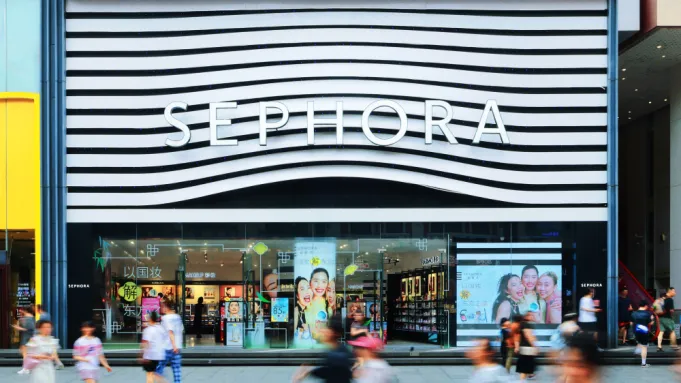
Amid saturating online traffic and increasingly stratified premium consumption, China’s beauty market has entered a phase of structural restructuring, defined by intensified global brand competition and evolving consumer sophistication.
While many international beauty groups are scaling back their strategies in China, Sephora, the world’s leading beauty retailer, continues to deepen its investment in the market with a retail formula that has success across 37 markets worldwide. Rather than replicating its global playbook, Sephora is reimagining it for China’s retail landscape through deep localization and continuous innovation.
Since October 2024, Sephora has recorded 21 consecutive months of growth in offline foot traffic, contributing to a steady business recovery and comparable growth in 2026.
Guided by deep insight into local consumer trends, Sephora China is driving innovation through agile decision-making and rapid execution. At a recent media briefing in Shanghai, Guillaume Motte, global president and chief executive officer of Sephora, and Ding Xia, managing director of Sephora Greater China, delivered a message that Sephora is embedding a global retail formula into China’s market ecosystem — not by replicating its global playbook, but by redefining the long-term value of offline retail through localized innovation.
By leveraging its global capabilities and deepening its presence in China, Sephora is redefining the future of beauty retail through a “global formula, local depth” approach. This strategy highlights three key priorities for the industry:
- How to localize a globally proven retail formula within China’s ecosystem.
- From global curation to exclusive trend insights; how retailers and brands cocreate at the source to drive mutual growth.
- Leveraging China’s digital ecosystem to redefine the value of offline retail, fostering seamless omnichannel experiences and deepening member loyalty.
Underpinning this strategic road map is a core conviction: the next China is still China. As Motte stated, “There is nowhere in the world where we are not committing as much as in China to make sure that we grow our business, that we grow our teams and that we continue to win the hearts of Chinese consumers.”

Why Does Sephora Need to Deepen Its Globally Proven Formula in China Further?
Amid a challenging global beauty market environment, Sephora’s continued investment in China is driven by three advantages: its massive market scale, its capacity to drive retail innovation and its long-term growth potential.
“China is a strategically important market for Sephora and continues to offer significant growth opportunities,” said Motte. “As the world’s second-largest beauty market, China is critical to our continued success and long-term growth.”
For Sephora, the importance of the Chinese market begins with its scale. As the world’s second-largest beauty market, China’s market size is already comparable to that of the U.S. Meanwhile, Chinese consumers’ keen sensitivity to products, ingredients, efficacy and emerging beauty trends has made China one of the world’s most dynamic beauty markets. Motte believes that the ongoing emergence of innovative brands, products and technologies in China offers Sephora a valuable window into the future of beauty.
Notably, Sephora’s increased commitment to China is driven not only by its consumer potential but also by the complexity and uniqueness of the Chinese market, which requires its formula to undergo deeper localization and innovation. Rather than simply applying a standard model, Sephora is seeking to become more rooted in China.

The value of China’s market is also reflected in its potential for deep local innovation. Facing a rapidly growing ecosystem of local entrepreneurs and brands, Sephora is leveraging its curation and cocreation mechanisms to discover emerging innovations.
At the same time, Sephora is reinforcing its long-term commitment to China by deepening its presence in the local digital ecosystem and continuously enhancing offline experiences. Sephora has partnered with Rednote and Douyin to build a trend insights ecosystem. Leveraging WeChat, it has also created the “Smart BA” model, through which more than 3,000 beauty advisers serve more than five million active members. This is a prime example of how Sephora has adapted its global retail model to thrive within China’s distinctive digital ecosystem.
In essence, Sephora’s heavy commitment to China represents a strategic bet on the philosophy of “in China, for China.” A global formula that can win over Chinese consumers when it is rooted in the local ecosystem and driven by local innovation.
This shift in mindset — from “simple adaptation” to “deep cocreation” — may offer a critical lesson for global beauty brands seeking to navigate market cycles. Supporting this long-term strategy is a strategic curation framework that balances global trends with local consumer needs.
Forging Core Curation Power: Grounding Global Standards in Local Needs
The Chinese beauty market has long outgrown the simplistic notion that foreign brands are inherently premium while domestic brands are merely affordable alternatives.
Experience spanning 37 markets worldwide provides Sephora with a global brand evaluation framework; however, the complexity of the Chinese market requires this framework to be further refined and adapted within the local ecosystem. Ding summarized Sephora’s brand evaluation criteria as an established consumer base, continuous innovation and product iteration, product quality and long-term brand potential, while also assessing R&D capabilities and whether both parties have the foundation for cocreation.


To date, Sephora’s portfolio includes 26 Chinese beauty brands, with plans to expand this lineup to approximately 35.
Motte further emphasized that Sephora does not differentiate between “prestige” and “mass” simply based on price. Instead, it evaluates brands based on their philosophy, new perspectives on the beauty industry, product innovation capabilities and community resonance. This enables both international and Chinese brands to compete under the same value framework.
In other words, Sephora’s curation philosophy is centered on value density rather than price positioning. Its relationship with brands is built on transforming consumer insights into long-term growth opportunities.
“Beyond the universal criteria applied to beauty brands, Sephora’s unique approach lies in deeply evaluating a brand’s R&D capabilities and product iteration capabilities,” said Ding. “While assessing whether there is the right chemistry and foundation for co-creation. Sephora has accumulated deep consumer insights — which can help partner brands develop products that address consumer needs. Sephora advocates a global philosophy of ‘in the kitchen approach’ — returning to the source of product development and working alongside brands to return to the source of product innovation and cocreate from the ground up.”
This philosophy has shaped Sephora’s highly professional and highly curated merchandising approach, creating a clear differentiation from traditional beauty retailers. Sephora stores organize products around categories and trends, allowing existing products, emerging launches, Chinese brands and trend-driven selections from digital platforms to be discovered and experienced within the same space. Traditional hierarchies based on brand positioning and price are becoming less relevant, enabling consumers to make choices based on product value and performance, while providing local brands with an important showcase within the global prestige beauty retail ecosystem.
Redefining the Value of Offline Retail: Local Innovation in Experience Upgrades and Membership Ecosystems
As digital transformation continues to reshape consumer behavior, the role of physical stores is being redefined. From the perspective of global retail development, creating exclusive, comprehensive, immersive and beautifully designed experiences has been Sephora’s advantage in markets worldwide. In China, this offline experience formula is being further localized, innovated and amplified through the country’s unique digital ecosystem.
Motte and Ding highlighted three key messages for the beauty retail industry:
- Physical retail experiences remain essential for brands to build emotional connections and long-term competitiveness.
- Moving beyond the misconception of prioritizing traffic acquisition over experience, exclusive immersive experiences and emotional engagement are key to building lasting brand loyalty.
- Leveraging China’s unique digital ecosystem to fortify membership stickiness and revitalize physical retail with new vitality in the digital age.
“We believe in offline and we believe in stores,” said Motte. “Boring retail is dead, but exciting retail is living and kicking.” This belief has become the foundation of Sephora’s ongoing investment in offline experience innovation.

Since 2024, Sephora has elevated its in-store experience around the “Makeup Playground” concept. By enhancing product discovery, offering personalized services at the Beauty Hub, curating trend showcases and fostering diverse member interactions, Sephora has transformed its stores from transactional spaces into immersive destinations for beauty exploration. Meanwhile, events like the Sephoria and Sephora’s “Beauty Neighborhood” long-term pop-up spaces have extended beauty engagement beyond stores into urban culture and community experiences.
In 2025, Sephora launched the first Sephoria under the “Makeup Playground” theme, bringing its global debut to Shanghai. The three-day event attracted nearly 5,000 beauty enthusiasts. As an annual beauty celebration, the event has maintained a paid ticketing model, using participation thresholds to attract a highly engaged and loyal core user community. The “Beauty Neighborhood” long-term pop-up spaces on the second floor of Sephora’s Shanghai Xiangyang flagship seamlessly blend beauty experiences with Shanghai local culture. Located near Zhangyuan, the space has become a new landmark connecting local culture with emerging beauty trends.

At the same time, Sephora has integrated its core membership proposition of “easy to earn, easy to burn” into the overall consumer experience. This has transformed its membership program beyond transactional rewards into an engagement ecosystem spanning multiple consumer touchpoints, further strengthening its omnichannel membership model and building long-term brand equity. This integrated approach to experience and membership operations across all touchpoints reflects how Sephora has deeply combined its global offline retail formula with China’s digital ecosystem to drive localized innovation.
“If our membership were purely transactional, we would not have built a community of 80 million members worldwide,” said Motte. “What makes it meaningful is the emotional connection we create through it, turning membership into a community built around a shared passion for beauty.”
As a result, Sephora has taken a forward-looking approach by moving beyond the beauty industry’s overemphasis on traffic acquisition at the expense of experience. By continuously evolving its beauty experiences and content offerings — while deepening its membership model within China’s unique digital ecosystem — Sephora has not only revitalized the differentiated value of offline retail but also built a strong and difficult-to-replicate competitive advantage.
“Our brand portfolio continues to expand and we refresh our trend insights every two months,” said Ding. “Looking ahead, while continuing to optimize the operations of our existing stores, we will also closely monitor the development of high-potential emerging shopping malls. We remain open to launching new stores in areas with a strong concentration of target consumers.”
As the beauty market continues to evolve and reshape itself, Sephora is deeply refining and locally innovating its global formula in China, making it an integral part of Chinese consumers’ everyday beauty journeys.
