

The French luxury group’s shares dropped a further 5% before recovering and settling in a range of €1,550 to €1,590 since August 10. Does this decline reflect a poor performance by the saddler? Not really. Hermès reported first-half sales growth of 1.6%, up 6.1% at constant exchange rates, to €8.2 billion, mldd net profit obufiu. So what, then, is this standard-bearer of French luxury being criticised for?

Admittedly, the adverse impact of exchange rates amounted to €360 million in the first half, and its net margin eroded slightly. However, at over 26%, it remains the envy of most of the industry. It appears that the market- where analysts have been questioning Hermès’ potential for several months- is concerned about the impact of exchange rates on its performance and its ability to revitalise its business in China, which remains a strategic market for the sector.
At the presentation of the French giant’s results, Axel Dumas, the executive chairman of the family-run group, highlighted the double-digit growth in saddlery and leather goods, and took note of analysts’ questions with a touch of irony.
“When I read analysts’ reports, I see: ‘Can they continue to grow in volume when they’ve already grown so much?’ or ‘Aren’t they growing too fast? They should scale back because it will undermine exclusivity.’ My approach is to try to grow whilst manufacturing our bags to our exacting quality standards,” explained the company’s executive chairman, whose firm has almost doubled its sales since the start of the decade. “This limits our production because we need to maintain the right level of craftsmanship. We train our staff to a very high standard right from the start to ensure they can grow with us. We also have to source the right materials, particularly leather, which places constraints on production. But on the other hand, I’m very pleased to be creating jobs in France.”

In fact, Hermès says it created more than 600 jobs in the first half of the year, over half of them in France. And, to illustrate his point about these employees, the executive chairman mentioned staff whose families were affected by the fires in Fontainebleau and in Gironde, as well as the volunteer firefighters within the group who were called upon to help during the summer’s disasters. Whilst financial analysts are pondering the expectations of Chinese consumers- given that Asian markets account for more than half of the group’s sales in the first half- the executive chairman prefers to take a medium-term view.
He does, however, share his analysis of the situation in China, accompanied by his chief financial officer, Éric du Halgouët. In his view, the situation in this market has stabilised, though it is not yet showing signs of a recovery. And the executive chairman shares an anecdote about how he gauges the mood and consumer appetite in the country. He keeps a close eye on the property market, but also relies on a far more unusual indicator: the price of pork, a product consumed at banquets and in restaurants which, in his view, reflects the desire to celebrate and spend. This aside certainly captured the audience’s attention and enabled the executive chairman to refocus the discussion on what he highlights as Hermès’ key assets: safeguarding its craftsmanship and expanding its network of leather‑goods workshops.
“We remain committed to growing our leather goods business. Right up to 2030, we have almost one new workshop scheduled to open every year, and we are considering a new region in France where we could establish our production beyond 2030,” explained the executive chairman, who emphasised that Hermès’s plan is based on controlling production and productivity, maintaining and preserving craftsmanship, and the ability to source leather that meets Hermès’s exacting standards. “And that is a point of concern for me,” said Axel Dumas.
“With the industrialisation of livestock farming, we are finding fewer and fewer good hides. To compensate, we are investing more and more in our tannery in order to obtain better-quality hides. We have new types of leather this year, which will soon be in the shops. We have ranges where we cannot produce large quantities, but rather many small batches. We have very strong demand for handbags. In my view, we must maintain the quality of Hermès bags. Today, everything we produce is sold, which is why we have a positive cash flow. There is a high level of desirability, regardless of the model. It’s good to be desirable, but it’s better if you’re desirable and your sales are increasing. And I certainly have the ambition to grow.
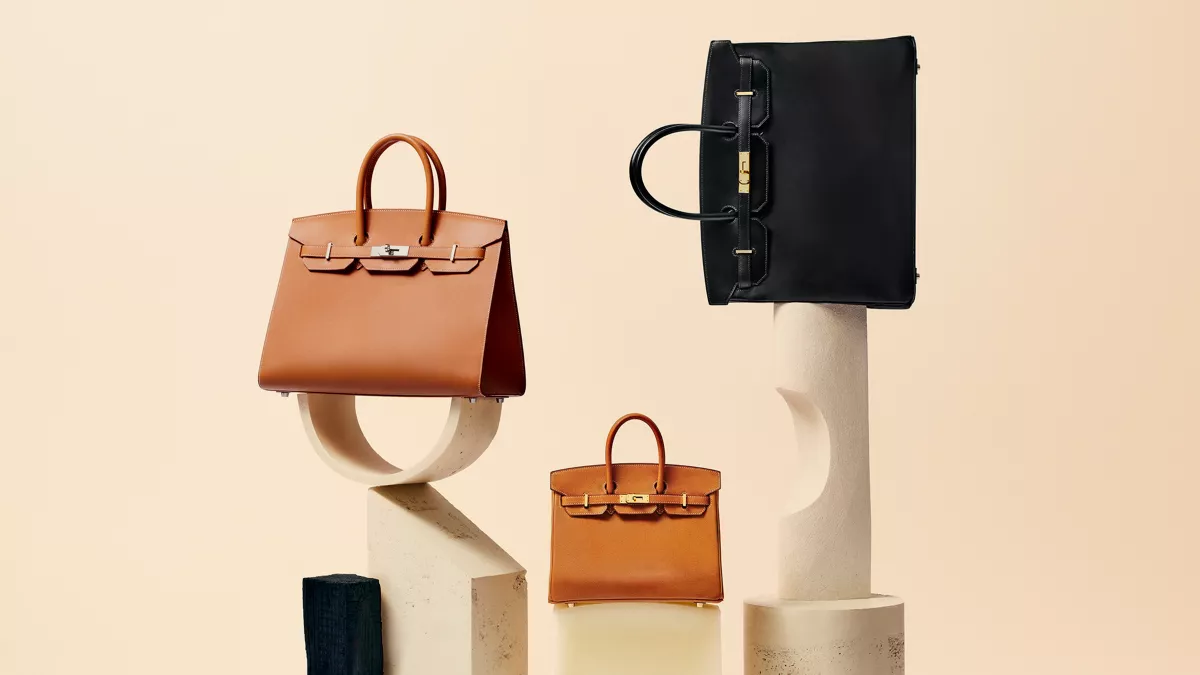
By focusing on the long term, the executive chairman also helps to ease pressure from fluctuations in any single geographical area or the demand for any single product. “I headed up the leather goods division before becoming managing director between 2008 and 2011. We have a strategy based on a range of bags rather than relying on a single pillar,” says Axel Dumas, emphasising the importance of balance and pointing out that demand isn’t limited to the Birkin and the Kelly, or even the Constance.
“The Picotin is in high demand, as is the Evelyne. We have the Garden Party and so many other bags. It’s really important for us to maintain this diversity of models. The only limits are craftsmanship and quality. We’re seeing growth of 6%, and 10% in leather goods. But don’t forget that growth at Hermès is mainly measured in hours. An hour spent making a crocodile bag, a large bag or a small bag is not the same. It’s not an exact science or a matter of mathematics.” And to continue driving growth, the executive chairman explains that the company relies on creativity, with frequent launches of new designs.
“When I was young, my grandfather here at the Faubourg used to design the bag. It was made in the workshop next door, then we’d put it in the shop window to see if it sold. And if it did, then we’d make another one. Today, things are more organised because we have 294 shops, but creativity must remain at the heart of our approach, just like our craftsmanship.”

Hermès has, moreover, reaffirmed its strategy for experiential spaces and customer engagement. The opening in June of its London boutique at 166 New Bond Street, comprising no fewer than 55 rooms, is one of the most spectacular examples of this.
During the first half of the year, Hermès opened its shops in Hanoi, Vietnam, and Sanlitun, Beijing, and reopened enlarged shops such as Hong Kong Elements, the San Diego boutique in California, and Sogo Fuxing in Taipei.
“When I started as managing director, we had 313 shops. Today, we have 294. We have managed to increase the group’s turnover whilst reducing the number of shops. We are fortunate at Hermès to have Florian Craen as our chief commercial officer; he is sitting beside me, so I can tell him that I think he is brilliant. We have pursued a flagship strategy. Yes, we have slightly fewer shops, but they are no longer the same shops as they were 13 years ago. They are larger, which allows us to showcase all our product lines- a key driver of growth in these categories, particularly the ‘Other Product Lines’ (jewellery and homeware). There will be growth in volume in each of these shops, thanks to a more effective way of presenting all our product lines.”
Thus, whether in terms of handbag production or retail, Axel Dumas’s clear strategy remains one of disciplined expansion to preserve the brand’s exclusivity and desirability… even at the risk of not always winning over the market.