

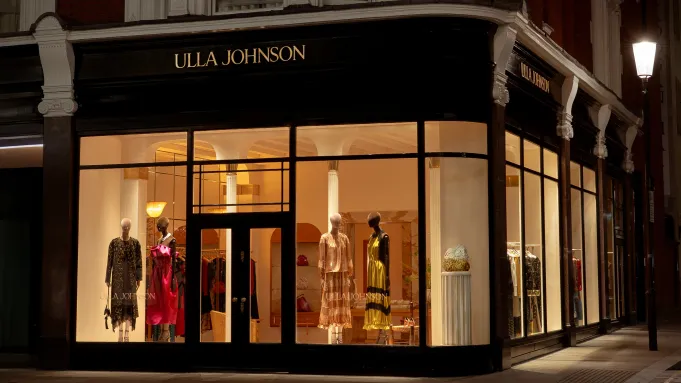
In a milestone in its international expansion, Ulla Johnson on Tuesday unveiled its first stand-alone store outside the U.S. at 150 Sloane Street here.
In an interview, the brand’s chief executive officer Thibaut Perrin-Faivre said the European flagship doubles as a “local community hub” and is a test case for further growth in the region and beyond.
“For us, London is the most important city outside the U.S. The city is our number-three city globally after New York and Los Angeles, so it was clear this had to be our first European store,” he said.
The corner site near the uber-affluent Sloane Square, in a building that also houses the British royal family’s go-to designer Emilia Wickstead, was selected to reach a concentrated local customer base.
“We know we have a lot of clients in the neighborhood, particularly in Chelsea. At the same time, Cadogan Estate is really trying to bring new, different brands to the area. They curate for the local clientele. It was a match made for both of us,” said Perrin-Faivre.
Johnson added that she was drawn to the area for its connection to community, and said: “It feels like a true neighborhood, and I cannot wait to see our brand become a part of it.”
The stand-alone unit also forms a synergy with the brand’s shop-in-shop at Harrods, opened in June 2025, which serves as an important volume driver, with strong appeal to Middle Eastern visitors.
“Harrods is a tourist destination. They curate very well for the Middle Eastern clientele, and we know we have a great Middle Eastern clientele. Our Sloane Street store is about serving the local client, the people who live in the neighborhood and shop with us regularly,” the executive said.
The London boutique will carry Ulla Johnson’s ready-to-wear and accessories, starting with the fall 2026 collection. The space was designed in collaboration with Italian architect and designer Giuseppe Porcelli, and follows what the company calls the warm, residential retail approach seen in its U.S. stores.
“Every physical expression of the brand has a residential touch,” Perrin-Faivre said of Ulla Johnson’s environments, citing the town-house-style Amagansett, N.Y., store and the plant-filled Los Angeles space as precedents.
“Every store is unique. The architecture, the curation of the assortment, and the team. We build a team embedded in the neighborhood. The store director and client advisers are part of the local community. That’s where the magic happens, when you can create relationships with the clients of the neighborhood and a local community around the store,” he added.
The Sloane Street flagship introduces an exclusive partnership with Mayfair-based Sarah Myerscough Gallery, known for contemporary craft and material-led work. The gallery will provide a rotating selection of artworks available for purchase, on display alongside pieces from Ulla Johnson’s personal collection.
For the opening, the selection includes a ceramic vase by Aneta Regel, two wooden vessels by Marc Ricourt and a straw and threadwork piece by Arko.
Perrin-Faivre linked the initiative to the brand’s focus on handcraft and materiality.
“It’s so important for Ulla to develop and create products that have meaning, that really bring her world to life. In this age of technology and artificial intelligence, I really believe having brands that still put human beings at the center is very important,” he said.
He highlighted the recently launched fragrance line as an example of that positioning. “We’ve created this bottle with a cap that is ceramic, and each cap is made by hand. The candle vessel is made by hand; everything is made by hand. It reflects her need to have the hand of a human being touching the product,” Perrin-Faivre added.
Since his sit-down interview with WWD in February 2025, Perrin-Faivre said dresses remain the core category, with silk gowns and runway pieces outpacing the broader dress offer.
Denim, launched four years ago, offers a fashion-forward, more casual take on the brand, while handbags, including the Charlotte, Lily, Paloma and raffia styles, are the fastest-growing category.
To better hone the London assortment, Perrin-Faivre said the company utilized e-commerce insights and cross-border shopping patterns.
“London is our number-one city outside the U.S. for the business. We also see many London clients in our Madison Avenue and Beverly Hills stores. They travel a lot, so we already had a strong understanding of their tastes,” he said.
“In clienteling patterns, we see the same in the Upper East Side and in Sloane Street. Clients shop very regularly; they come multiple times per month, they love to build a trust relationship with a client adviser, and they do consignment for their multiple homes,” Perrin-Faivre continued.
The main distinction between the two cities is how British clients dress for social occasions.
“The local U.K. client loves events. There are many outdoor events in London: the Chelsea flower show, Royal Ascot, and weddings. We curate a lot for the client who loves eventing and outdoor social life. In the U.S., events tend to be more indoor,” he said.
Looking at the wider business, Perrin-Faivre said the London opening is part of a careful expansion strategy.
In Europe, Ulla Johnson is testing markets through outposts and concessions, including a presence at Galeries Lafayette in Paris. Customers from the Middle East and Southeast Asia have also expressed an appetite for the brand.
In the Gulf region, the company already partners with Harvey Nichols and Bloomingdale’s and is considering standalone stores. In Southeast Asia, Ulla Johnson is opening with Galeries Lafayette in Indonesia, and Perrin-Faivre is tracking opportunities in Thailand, Indonesia and Australia, first via wholesale and potentially with dedicated stores later.
By contrast, China remains a secondary priority due to intensified competition from major luxury groups.
“China is, of course, massively important. But it’s a very competitive market, with big groups putting a lot of money there. For us, as a more privately owned, smaller company, I would rather find opportunities in countries with less economic pressure,” said Perrin-Faivre.