

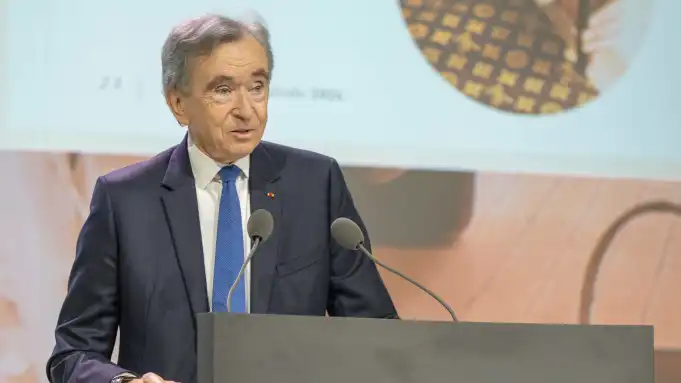
PARIS – Bernard Arnault warned on Thursday that the conflict in the Middle East could spell “catastrophe” for the world economy this year unless a rapid resolution is found.
Speaking at LVMH Moët Hennessy Louis Vuitton’s annual general meeting in Paris, the French luxury group’s chairman and chief executive officer said it was impossible to make near-term forecasts due to the uncertain outcome of peace talks between the United States and Iran.
But he was optimistic about growth in the midterm, dismissing speculation about his succession by saying he expects to remain at the helm of the group for another “seven or eight years” at least.
“In the short term, it has not escaped your attention that the world is now in a fairly serious crisis in the Middle East,” Arnault told the assembly.
“It all depends on how this crisis plays out. Either it will be a global catastrophe, so to speak, with extremely serious and highly negative economic impacts, and if that’s the case, who can say how 2026 will unfold?” he said.
“Or it will be resolved more quickly somehow, as we all hope — even if it doesn’t look easy. And in that case, business will gradually return to normal. At any rate, it’s quite unpredictable. If the second scenario is confirmed, I think growth in our various activities will resume. If not, we will be faced with a crisis. It won’t be the first, and chances are we will continue to gain market share, as we did in 2025,” he added.
LVMH reported revenues in the first quarter fell 5.9 percent on a reported basis and rose 1 percent in organic terms as the Middle East conflict capsized a “positive start to the year” in that luxury-loving region, which accounts for roughly 6 percent of its business. The war had a negative 1 percent impact on group organic growth.
Faced with near-term volatility, the luxury magnate said he prefers to look further ahead, underlining that as a family-run group, LVMH always plans for the next few decades.
“What excites, motivates and entertains me is what the group will look like, and how will it be positioned, in five years’ time,” he explained. “I think we’re very well placed to remain by far the leader in the luxury sector.”
He touted strong uptake for Jonathan Anderson’s first collection as creative director of Dior, the jewel in the crown of the LVMH empire, which groups around 75 brands, including Louis Vuitton, Sephora, Moët & Chandon and Tiffany & Co.
“It’s off to a flying start, so much so that we’re having trouble delivering products because demand is so high,” Arnault said.
Meanwhile, he said there is a waiting list “in the thousands” for Vuitton’s P9 bag, launched by creative director of menswear Pharrell Williams. The brand recently launched a dedicated advertising campaign for the style, featuring the personal items inside the bags of brand ambassadors including Jeremy Allen White, LeBron James and Jackson Wang.
“We’re producing it as fast as we can, with artisans who each work on one product. It takes time,” Arnault said. His remarks appeared designed to position Vuitton in a similar bracket to Hermès, which remains the gold standard for the production of ultra-exclusive French leather goods.
The executive also reiterated his ambitions for Tiffany, which he expects to topple Cartier, owned by Compagnie Financière Richemont, as the market leader. “We should aim for Tiffany to be the number-one jewelry brand in the world in five years. We’re not far, but we’re not there yet. In five years, however, I think we can achieve it,” he said.
“In sum, this is why I’m very confident about the prospects for our group over the next five years, and why, when the share price is falling, as it has been recently, I buy them back,” Arnault noted wryly. “In business, you must always be patient.”
With LVMH shares tumbling more than 25 percent since the start of the year, the Arnault family has continued its purchases, recently crossing the threshold of 50 percent ownership in the group. It acquired shares worth 1.6 billion euros in 2025 and 1 billion euros so far this year, said chief financial officer Cécile Cabanis.
An upbeat Arnault fielded questions from shareholders about everything from prospects in China to the thorny issue of succession, amid renewed speculation of dissent among his five children, who are viewed as vying for the top job in a race that is often compared to the HBO series “Succession.”
For the first time, all five — Delphine Arnault, chairman and CEO of Christian Dior Couture; Antoine Arnault, director of image and environment at LVMH; Alexandre Arnault, deputy CEO of Moët Hennessy; Frédéric Arnault, CEO of Loro Piana, and Jean Arnault, watch director at Louis Vuitton — took the microphone to address shareholders.
“You saw the children. Do they seem very ambitious? I don’t know. That’s up to you to say,” the 77-year-old patriarch said ironically in response to a question. He stressed that shareholders last year approved by more than 99 percent a resolution allowing him to remain in his post until the age of 85. “Let’s talk about it again in seven or eight years, shall we?”
Antoine Arnault’s appointment to the executive committee in February alongside his sister Delphine was seen as bolstering the two elder siblings’ standing within the group. They are born of Arnault’s first marriage with Anne Dewavrin, while the three younger brothers are the product of his union with Canadian pianist Hélène Mercier-Arnault.
In a series of recent interviews to promote her new album, Mercier-Arnault sought to quell talk of a family feud, though her remarks only added fuel to the fire, renewing scrutiny of the succession issue, with a growing number of analysts pushing for clarity on the topic.
Asked on the sidelines of the meeting what should be read into his children each taking their turn to speak, Arnault responded: “Nothing. It’s because I have a very good relationship with my shareholders, and my shareholders are kept informed of the activities of each one of them, who focus on a specific area and are all five, as you can tell, very good at what they do.”
Delphine Arnault described Anderson’s arrival last year as a “cultural revolution” at Dior, while Alexandre Arnault cited the African continent as a huge potential market for wines and spirits, which saw the sharpest decline in revenues of any business group last year. He was just back from South Africa, which he said was the third-largest market for Hennessy cognac after China and the United States.
Bernard Arnault said LVMH was also well positioned to capitalize on a recovery in Chinese luxury demand. “It’s the second largest market after the United States, therefore I remain confident and not too worried about the evolution of this market, where prospects remain great for our group,” he said.
He noted Vuitton’s boat-shaped flagship in Shanghai, opened last year, draws 100,000 visitors a week.
“It’s quite amazing. I’ve been there several times, and was even congratulated by the general secretary of the [Chinese] Communist Party. That would never have happened in France. Can you imagine if we tried to build a Vuitton ship on Place de la Concorde?” he said.
“There, we got it done in less than a year. It also shows how dynamic other countries where we operate are, compared to the heaviness of our old Europe, which is very slow to pick up and modernize, always tangled up in red tape, which can be hellish,” he lamented.
Among LVMH’s upcoming projects are Dior flagships in Osaka and Milan. Arnault said the group is also mulling a Cheval Blanc hotel in Florida with an “incredible architect,” and denied reports that he’s considering a sale of La Samaritaine department store in Paris. “We’re going to make it work because until now, it’s been a little weak,” he pledged.
On a lighter note, he pointed to his watch, a Louis Vuitton Tambour Einstein Automata that features a reproduction of a famous photo of Albert Einstein. “You press a button that sets off this incredible mechanism where Einstein pulls his tongue. I’ll show this to the administrators at the board meeting later,” he said with a smile.